Drawer Dividers or Open Trays? Giving Small Items a Home
Drawer dividers or open trays can tame loose household bits; learn which suits your drawer, what causes clutter to return and how to choose a workable home.
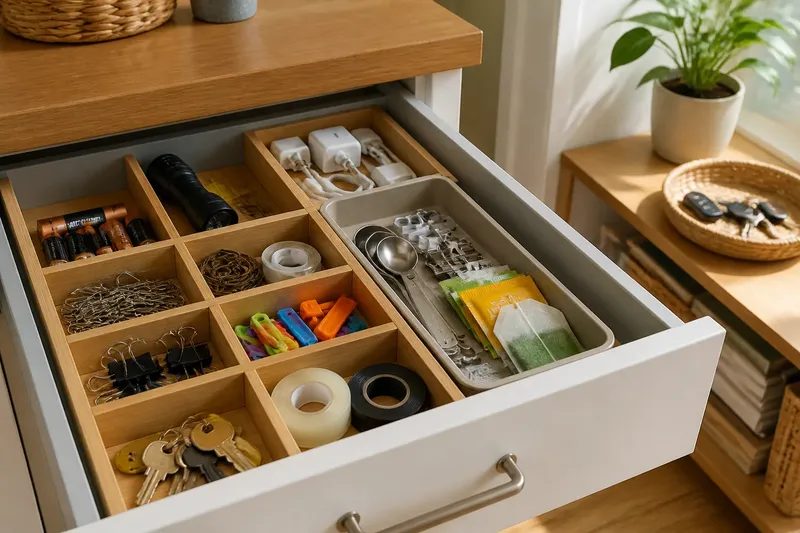
You open the kitchen drawer for a teaspoon and find a rubber band looped around a bottle opener, a spare battery and three loose clips. Drawer dividers or open trays can give these small household items a more useful home, but the right choice depends on how you reach for them and how the drawer behaves.
Dividers create separate compartments inside the drawer. Open trays are small containers with no lid, used loose on a shelf, worktop or drawer base. Both can reduce rummaging; neither helps much if the container is awkward to reach or the contents have no clear reason to stay together.
Drawer dividers or open trays
Start with the action you repeat. If you pull out a drawer and want each kind of item to stay in its own place, dividers may suit you. They keep objects contained when the drawer opens and closes, and can make a shallow drawer useful for several categories.
Open trays are easier to lift, move and rearrange. They work well for items used in different places, or for a shelf where a drawer is not available. A tray can also be a helpful temporary home while you decide what belongs together, rather than a permanent arrangement that must fit a fixed set of compartments.
Visibility is not simply a matter of seeing the contents. A deep drawer can hide things at the back even when it has divisions; a tray on a high shelf may be visible but awkward to reach. Consider the angle from which you look, the depth of the container and whether you can lift or slide it without disturbing neighbouring items.
Categories that keep breaking
A common problem is a compartment that collects a jumble despite the dividers. This usually happens when its category is too broad: “bits and pieces” has no useful boundary, so almost anything small can land there. The problem is not necessarily the divider; it is the rule for what belongs inside.
Choose categories based on a shared use or a clear kind of object. In a household desk drawer, for instance, paper clips and drawing pins might share a section if they are both used for paper tasks, while spare keys need a separate place. If two groups are constantly mixed up, give them distinct sections or use a small tray for one of them.
There is a reverse problem too: too many compartments. Tiny sections can make a drawer feel organised while leaving no room for the irregular objects that are actually used. Try combining categories that are reached for together, and leave one slightly larger space for objects whose shape varies, such as tape rolls or charging adapters.
Contents that shift around
Items can slide from one compartment into another when a drawer is pulled briskly, especially if a divider is loose or a section is much wider than its contents. A tray inside the drawer can contain a small group more reliably than a low divider, while a non-slip liner may help keep a lightweight organiser in place.
Before buying anything, check the drawer’s interior shape, including any runners, handles or uneven corners. Removable, adjustable dividers can accommodate a drawer whose contents change, while fixed inserts make more sense when the categories are stable. For a tray on a shelf, check that its base sits flat and that its sides are high enough to hold the objects without hiding them.
Do not make the container larger than the space you can comfortably use. A tray that nearly fills a shelf can be difficult to lift, and an organiser that leaves no room for fingers can make access slower. Keep the items you use often nearest the opening or at the front of the shelf.
Items that need quick access
Small things used repeatedly are easy to misplace when they are hidden under less-used objects. In a kitchen, that might mean keeping everyday tea clips and measuring spoons in a front section, with occasional tools elsewhere. On a hall shelf, a shallow tray can gather the keys and coins that are routinely set down there without requiring a drawer to be opened.
Think about whether you need to see an item before choosing it. A tray with low sides can show its contents at a glance, but loose objects may be easier to knock out. A compartment can protect the group from spreading, though tall sides or a deep drawer may conceal what is inside. For visually similar objects, such as spare keys, a label on the compartment or tray can save a search.
Say you keep spare batteries, a small torch and cable ties in a kitchen drawer, but use the torch during power cuts and the other items only occasionally. A shallow tray near the front could hold the torch, while a divided section farther back keeps the less-used supplies together. The expected result is that the frequently needed object is easy to spot, without letting its place dictate where every small item goes.
Trays that migrate
A tray can be convenient to carry and also prone to wandering. If it travels between the kitchen, sitting room and bedroom, its contents may stop having a dependable home. This often means the tray has been assigned more than one purpose, or that no one knows which surface it should return to.
Give a mobile tray a defined destination and a limited job. A small repair tray might hold the thread, spare buttons and scissors currently being used, then return to a particular shelf when the task is finished. If household members need the same items in several rooms, separate small supplies near each point of use may be clearer than moving one tray around.
For a tray that stays on a surface, make sure it is not simply a landing place for every object without another home. Keep its category narrow enough to recognise, such as “items to return upstairs”, and empty it as part of the routine that suits your household. A tray can collect a temporary group; it cannot decide what should happen to it.
Choosing the right container
Use these checks to choose between a divider and a tray:
- Check the location: For a drawer with several stable groups, try dividers; for a shelf or a group that needs carrying, consider a tray.
- Check how often you reach in: Put frequent-use items towards the front or in a shallow, visible container.
- Check the object shapes: Choose flexible compartments or a larger tray for irregular items that do not fit neat rows.
- Check whether things shift: Use snug sections or a tray with suitable sides if the contents scatter during ordinary opening and closing.
- Check access around the container: Leave enough room to lift a tray or grip an item without moving everything else.
- Check whether the categories are clear: If you cannot decide what belongs together, sort the items first and choose the container afterwards.
Material matters, but it should follow the setting. Plastic trays are easy to wipe; bamboo or wood can feel at home in a visible shelf arrangement; fabric organisers may suit soft accessories but can be harder to keep crisp around dusty hardware. Follow the maker’s care guidance, particularly where moisture or food-related use is involved.
When should a drawer use dividers?
Are adjustable dividers useful?
They are useful when the drawer’s contents or categories may change, because sections can be widened or moved. Check that the dividers stay in place during normal use rather than assuming every adjustable design will suit every drawer.
Do small items need separate compartments?
Only when separating them makes retrieval easier or prevents one kind from getting mixed with another. Items used together can share a section, while a confusing catch-all may be better split into a few recognisable groups.
Can a tray work inside a drawer?
Yes, particularly for a small group that you want to lift out as one unit. Make sure the tray leaves room to open the drawer fully and does not block access to other contents.
How can a tray stay organised?
Give it a narrow purpose and a regular destination, such as one shelf or one household task. If unrelated objects keep accumulating, move them to appropriate homes rather than adding another tray beside it.
A home that stays usable
When an arrangement stops working, notice the specific friction: searching, shifting, reaching over other objects or carrying a container back and forth. Change one feature at a time, such as moving a frequently used section forward or replacing a broad category with two clearer ones. Drawer dividers or open trays are most useful when their shape supports the way the items are handled, not when the arrangement merely looks tidy.
Leave a little room for the household to change. A useful compartment should accept the objects that genuinely belong there without forcing unrelated items into it, and a useful tray should be easy to return to its place. That small allowance keeps the system practical as routines and possessions shift.