Why a Clear Route Through a Room Changes Its Feel
A clear route through a room makes everyday movement easier to read. Learn to spot pinch points before moving furniture and preserve useful space.
On a rainy afternoon, someone carrying a mug from the kitchen has to turn sideways between the sofa and a low table. That small detour is a clue: the room’s layout is shaping how people move through it. A clear route through a room can make the same furniture feel less intrusive, even before anything is moved.
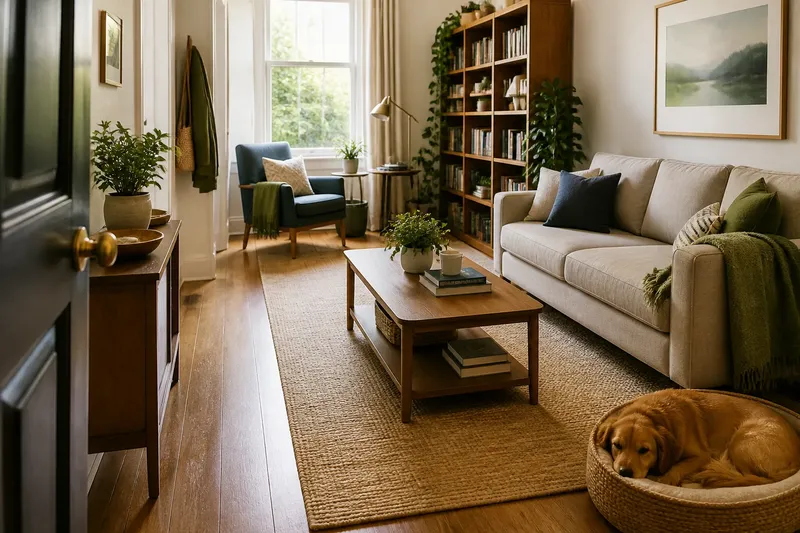
Consider an invented situation. Say Mara shares a rectangular sitting room with her partner and a dog. The sofa faces a bookcase, an armchair sits beside the window, and a low table occupies the middle. The room looks orderly, but people regularly sidestep the table to reach the window, and the dog’s bed narrows the way to the door. Mara’s first task is not to buy furniture or rearrange the room. It is to notice the routes already in use.
Watch the room in use
A route is the line of travel between places people use: a doorway and a seat, a sofa and a lamp, or the entrance and a window. It is not necessarily a straight line. People naturally bend around furniture, follow familiar habits and take the route that feels least awkward.
Mara pays attention during ordinary activities rather than asking the room to perform for a tidy photograph. She notices where her partner walks after coming in, how she reaches the armchair with a book, and where the dog settles when people are seated. These repeated movements reveal which parts of the room need to connect.
She also distinguishes a preferred route from a route people tolerate. If someone repeatedly turns sideways, pauses to move a cushion, or steps around an object, the path may be technically usable but still feel constrained. A single awkward moment may be incidental; a repeated detour is more useful evidence about the layout.
Find the pinch points
A pinch point is a place where movement becomes awkward because the usable path narrows or changes direction abruptly. The obstruction might be a table corner, a chair pulled away from its usual position, a trailing basket or an open door. The source can be small, but its position matters because it lies on a route people use.
To identify these spots, Mara observes the room from the entrance and then from the places where people sit. She looks for the moments when someone has to turn, pause, reach over an obstacle or shift an object. She checks the route while the room is in its normal state: cushions are on the sofa, the dog’s bed is in place and a book may be resting on the table.
She avoids judging the room only from above or from one viewpoint. A gap that appears generous from the doorway can feel tight when approached carrying a tray. The reverse can also happen: furniture may look close together but leave a comfortable route because people pass beside it rather than between it.
Trace the main journeys
Mara makes a simple mental map of the journeys that matter most. One starts at the room’s entrance and ends at the sofa; another runs from the sofa to the window; a third connects the armchair to the bookcase. She does not try to make every possible crossing equally easy. Instead, she gives priority to routes that recur and to movements that involve carrying something or sharing space.
In this invented situation, the journey to the window crosses the centre of the room, while the journey to the bookcase skirts the wall. The table sits across the more frequent crossing. The dog’s bed, meanwhile, is not troublesome simply because it occupies floor space; its position narrows the route from the entrance. That distinction helps Mara consider relocation without treating every object as an obstacle.
She watches how two people pass, too. If one person has to stop while another uses the main route, the room may have a conflict between a through-path and a place to sit. The aim is not an empty corridor through the sitting room. It is a layout in which ordinary movement does not repeatedly interrupt another activity.
Test before moving
Before changing the furniture, Mara marks the proposed path with a length of painter’s tape on the floor. She uses it to picture a route from the entrance to the sofa and leaves the table in place for the moment. The tape is a visual prompt, not a measurement standard: it helps her see whether a route bends around a corner or passes through the centre of an activity area.
She then tries a small, reversible change. In this hypothetical example, she shifts the dog’s bed away from the entrance-side pinch point and turns the low table so its corner no longer faces the main crossing. The expected observable result is that someone can enter and reach the sofa without the usual sidestep, while the table remains within reach from the seats.
Mara lives with the arrangement during normal use rather than judging it immediately. She notices whether people still walk around the table, whether the dog chooses the new bed position, and whether the armchair remains comfortable to approach. If the route works but the table becomes inconvenient, she can adjust its position again. A temporary trial makes the decision easier to reverse.
What should the route prioritise?
Should every route be straight?
No. A gentle turn can feel natural if it leaves a clear passage and avoids interrupting a seated area. The useful question is whether people can follow the route without repeated sidestepping or moving objects.
How can a pinch point be spotted?
Watch for recurring pauses, sideways turns, bumped corners and objects people shift before passing. Notice whether the same spot causes difficulty from more than one direction or during a particular everyday activity.
Does furniture have to move first?
No. Observe the room as it is, and use painter’s tape or a temporary object-free path to picture a change before committing to it. Small reversible adjustments can clarify whether the furniture or a movable item is causing the difficulty.
What if people use different paths?
Give attention to the journeys that happen most often and to places where paths cross. A room can support more than one route, but its regular users should not have to negotiate the same awkward bottleneck each time they move through it.
Keep the room usable
After the trial, Mara keeps the arrangement that supports the room’s actual habits, not the one that merely looks most symmetrical. She leaves the routes to the sofa and window clear, while keeping the table close enough to serve the seats. The dog’s bed stays where it is out of the entrance path, so the room retains a comfortable resting place without narrowing the way in.
This is the practical value of a clear route through a room: it makes movement easier to read and shows which objects are in the way because of their position, not simply because they occupy space. When a layout feels awkward, watch a familiar journey before moving heavy furniture. The route people already take can point to the smallest change that makes the room easier to use.